
Influence: The Psychology of Persuasion
The book that explains why people say yes. First published in 1984 and expanded in 2021 with a seventh principle. Dr. Cialdini’s books, led by Influence, have sold more than 7 million copies in 44 languages.
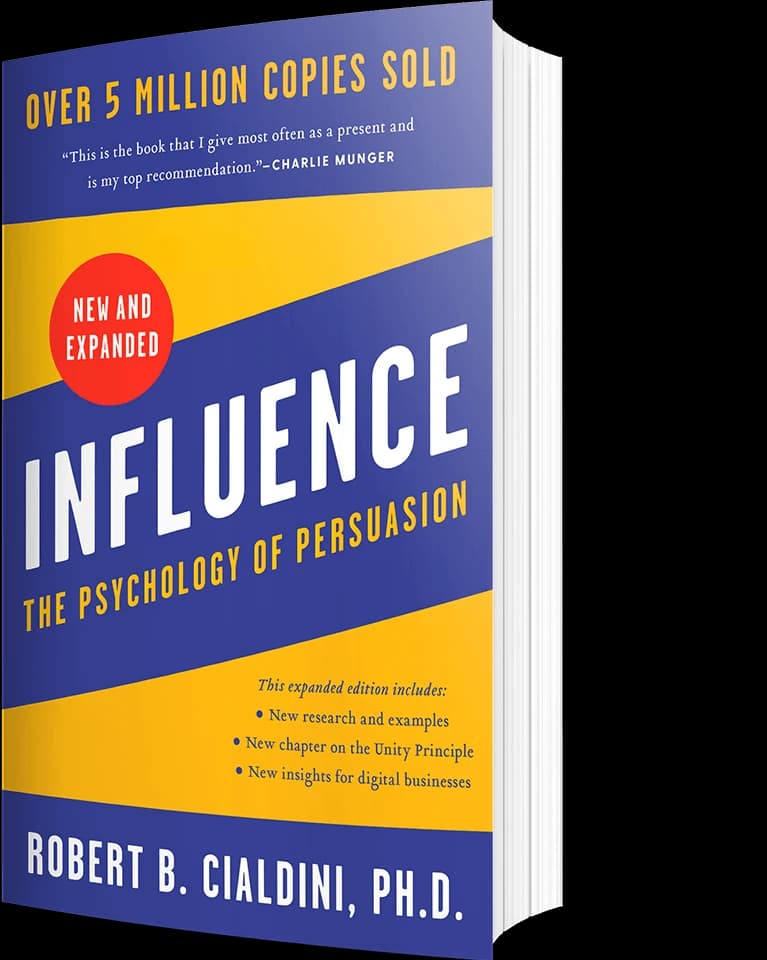
Why people say yes.
Influence answers one question: what leads a person to agree to a request? Dr. Robert Cialdini, a social psychologist at Arizona State University, found that most decisions to comply follow a small set of principles. Each one is usually a sound shortcut, which is why it works, and why it can be exploited.
The book shows the research behind each principle, how it plays out in sales, marketing, management and daily life, how to use it honestly, and how to recognise and defend against it when someone uses it dishonestly.
How it was researched
Besides decades of laboratory and field experiments, Cialdini spent years undercover. He signed up for the training programs of people who persuade for a living, among them car sales, fundraising and telemarketing, to learn which tactics consistently worked. The same few principles kept appearing beneath very different methods.
The seven principles of persuasion.
Six principles in the original; Unity was added in the New and Expanded edition. Each has a full guide here, with the research and how to use it.
- IReciprocityReciprocity is the rule that obliges us to repay what another person has given us.
- IIScarcityScarcity is the tendency to assign more value to things that are rare, dwindling or hard to obtain.
- IIIAuthorityAuthority is the tendency to defer to people we take to be knowledgeable or entitled to direct us.
- IVCommitment and ConsistencyPeople want to act in ways consistent with what they have already said and done.
- VLikingWe agree more readily with people we like, and the things that make us like someone are more mundane than most people expect.
- VISocial ProofSocial proof is the tendency to decide what is correct by finding out what other people think is correct.
- VIIUnityUnity is the most recently identified of the principles, and it is not a stronger form of liking.
- All seven, explained →
From reading it to using it.
The Cialdini Institute is the training institute Dr. Cialdini founded. We don’t publish the book; we teach people to apply it. In the Cialdini Certified Practitioner program, each principle in Influence has its own module, taught by Dr. Cialdini on video, with exercises on your own situations and a personal Action Plan. The POP® Workshop teaches the same principles in person, over two days.
Which edition to read.
1984 · William Morrow
Influence: The Psychology of Persuasion
The original. Six principles: reciprocation, commitment and consistency, social proof, liking, authority and scarcity.
Academic edition
Influence: Science and Practice
The companion for instructors, researchers and students, with deeper treatment of the research behind each principle.
2021 · Harper Business
Influence, New and Expanded
The current edition and the one to read. It adds the seventh principle, Unity, along with new research, new examples and online applications.
Also by Dr. Cialdini: Pre-Suasion, Yes! and The Small BIG. About the author: Robert Cialdini’s biography.
What its readers say.
“'Influence' is one of the best business books of all time.”

Warren Buffett
CEO, Berkshire Hathaway
“Robert Cialdini has had a greater impact on my thinking than any other scientist.”

Charlie Munger
Vice Chairman, Berkshire Hathaway
“'Influence' is a book that made me a billionaire.”

Tobias Lütke
Founder, Shopify
About the book.
What is Influence: The Psychology of Persuasion about?
It explains why people say yes. Robert Cialdini identifies the principles that lead people to agree to a request, shows the research behind each one, and teaches how to use them ethically and how to recognise when they are being used on you.
What are the principles in Influence?
Reciprocity, Commitment and Consistency, Social Proof, Authority, Liking and Scarcity in the original 1984 book, and Unity, added in the 2021 New and Expanded edition. That makes seven principles in the current edition.
Which edition of Influence should I read?
The New and Expanded edition (Harper Business, 2021). It contains all seven principles, including Unity, and updates the research and examples, including online applications. Influence: Science and Practice is the academic version for instructors and students.
How was Influence researched?
Alongside decades of laboratory and field experiments, Cialdini spent years undercover, signing up for the training programs of people who persuade for a living, including car sales, fundraising and telemarketing, to see which tactics consistently worked and why.
What is the difference between Influence and Pre-Suasion?
Influence explains the principles that move people to say yes. Pre-Suasion (2016) is about the moment before a request: how what people are focused on just before a message changes how they respond to it. Read Influence first.
How many copies has Influence sold?
Dr. Cialdini's books, led by Influence, have sold more than 7 million copies and been translated into 44 languages.

You've read Influence. You can use it on Monday.
Get the free 39-page playbook: word-for-word scripts, checklists and scorecards that put the book's principles to work.